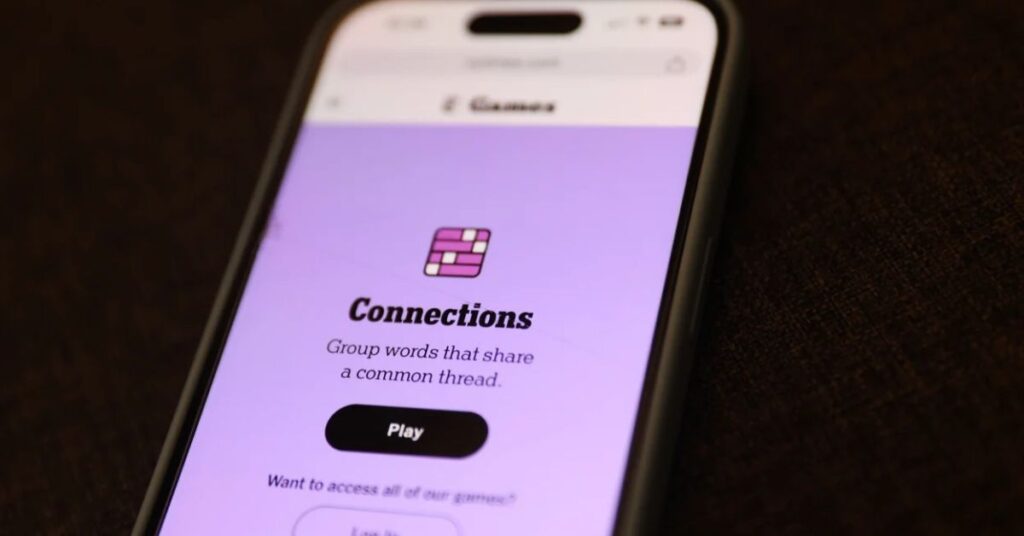
If you enjoy word puzzles but do not want to see the answer immediately, connections hints today mashable can be a useful search phrase when you need a gentle push. Mashable regularly covers popular internet games and puzzle culture, while Connections has become a daily word-association challenge for players who enjoy finding links between seemingly unrelated terms.
The goal is simple on the surface: sort 16 words into four groups of four. The challenge comes from the fact that several words can appear to fit more than one category. One word may belong to a clear group, while another seems designed to distract you.
This guide explains how to approach the grid, understand its difficulty levels, avoid common mistakes, and use hints without ruining the experience. You will also learn how daily solving can improve pattern recognition and how to track your progress over time.
Strategies for Decoding the Grid
Start by scanning all 16 words before making a selection. Looking at the entire board helps you notice repeated ideas, related meanings, phrases, abbreviations, names, objects, or other possible connections. Avoid locking onto the first group that looks obvious. Puzzle designers often include words that could reasonably fit multiple categories.
A useful technique is to search for a group with a very specific connection. For example, four words that can follow the same word or four items belonging to one narrow category may be stronger evidence than four words that simply feel related. Specific connections are easier to defend because fewer alternatives exist.
Once you identify a likely group, test each word against the category. Ask whether every item fits naturally, not merely technically. Then consider the remaining words. If removing your proposed group creates clearer relationships elsewhere, that is another sign you have found a legitimate connection.
When using connections hints today mashable as a search term, remember that a hint should support your reasoning rather than replace it. A category clue can be enough to get your brain moving again without revealing the complete solution.
Understanding the Difficulty Tiers
Connections uses four category colors to communicate difficulty. Yellow is generally the easiest group, followed by green and blue, while purple is usually the most difficult. The colors do not describe the individual words. Instead, they represent the relative challenge of identifying each category.
The easiest group often has a direct or familiar relationship. More difficult groups may rely on wordplay, alternate meanings, cultural references, spelling, or a particular phrase structure. Purple categories are especially likely to require a second interpretation of a word.
However, difficulty can feel different from one player to another. A category involving sports terms may be obvious to a sports fan but difficult for someone unfamiliar with that vocabulary. Likewise, a pop-culture reference may be easy for one generation and obscure to another.
This is why it helps to treat the color system as a general guide rather than a personal score. If a supposed easy group seems unclear, move on. Another category may reveal the intended meaning of several remaining words.
Common Pitfalls to Avoid
The biggest mistake is making a group simply because four words appear related. Connections is built around misleading relationships. Four words can share a broad theme while only three actually belong to the intended category. Before submitting, identify exactly why each word fits.
Another common problem is committing too early. If you have only a vague connection, leave those words on the board and investigate other possibilities. A temporary theory costs nothing. A wrong submission, however, can use one of your limited mistakes.
Watch for words with multiple meanings. A word might describe an object, an action, a person, or part of a familiar expression. The puzzle may use one meaning while encouraging you to think of another. Capitalization, punctuation, and wording can sometimes provide useful clues as well.
Finally, do not assume the most familiar interpretation is correct. If one category seems almost too obvious, inspect it carefully. The puzzle may be testing whether you can distinguish a broad association from the precise relationship intended by the creators.
Utilizing External Resources
External hints can be useful when you have genuinely exhausted your own ideas. Search results for connections hints today mashable may lead you to clue-based coverage designed for players who want assistance without immediately seeing every answer. This approach can preserve some of the puzzle-solving experience.
A good hint progression is gradual. First, look for a general strategy or category-level clue. If that does not help, use a stronger hint. Only check the complete answers when you are comfortable ending the solving process. This turns outside information into a learning tool instead of an automatic shortcut.
You should also distinguish between current puzzle coverage and older articles. Daily puzzle content changes, so a page from a previous date may discuss a completely different grid. Check the publication date and puzzle date before relying on a result.
When reading third-party coverage, focus on clearly presented information rather than unsupported claims. Reputable puzzle reporting should distinguish clues from answers and avoid pretending that an unofficial interpretation is an official explanation.
The Role of Word Association
Word association sits at the heart of Connections. The puzzle asks you to move beyond individual definitions and recognize relationships between words. Those relationships can involve synonyms, categories, phrases, names, abbreviations, objects, actions, or cultural references.
Strong solvers often shift between broad and narrow thinking. Begin broadly by asking what several words have in common. Then narrow the idea until it becomes specific enough to explain every item. For example, instead of thinking that four words are simply related to music, look for the exact musical connection that links them.
Context also matters. A word that seems unrelated may become obvious when paired with another word. Think about common expressions and compound phrases. Sometimes the intended connection is not between the words themselves but between each word and an unstated word.
This makes Connections different from a straightforward vocabulary test. You are not only recalling definitions. You are testing hypotheses, recognizing patterns, eliminating alternatives, and adjusting your interpretation when the board suggests another possibility.
Tracking Your Progress Over Time
Keeping track of your daily results can reveal patterns in your solving style. You might discover that you regularly identify straightforward categories but struggle with wordplay. Another player may have the opposite experience. Tracking mistakes helps you see where your reasoning tends to break down.
Record simple details such as whether you solved the puzzle without hints, how many mistakes you made, and which category caused the most trouble. You do not need a complicated spreadsheet. A short daily note can provide enough information to identify recurring weaknesses.
Over time, look for improvement rather than perfection. A difficult puzzle can still teach you something even if you need a hint. After checking an answer, review why the category worked. Understanding the intended connection is more valuable than simply knowing which four words belonged together.
If you use connections hints today mashable or another hint source regularly, you can also record how much assistance you needed. Gradually reducing that assistance can become a practical personal goal without turning the game into a high-pressure competition.
Benefits of Daily Puzzle Solving
Daily word puzzles provide a compact way to practice attention, vocabulary, association, and flexible thinking. A Connections grid requires you to compare multiple possibilities at once. You must notice similarities while also recognizing when a similarity is too broad to be useful.
The game also encourages cognitive flexibility. When your first theory fails, you need to abandon it and consider another interpretation. That habit of revising a hypothesis is part of ordinary problem-solving, even though a puzzle provides a much smaller and more controlled setting.
There is also a social element. People often discuss daily grids, clues, unusual categories, and surprising solutions. That conversation can introduce you to new words, cultural references, and ways of thinking about language.
Still, a daily puzzle should remain entertainment. You do not need to solve every grid perfectly. Using a hint, taking a break, or returning later can be part of the experience. The value comes from engaging with the problem, not from proving that you never needed help.
Frequently Asked Questions
How often are the puzzle categories updated?
The Connections puzzle changes daily, with a new grid presenting four new categories. Because the content changes, always check the date when searching for current hints or answers.
What should I do if I get stuck on the last group?
Recheck the remaining words for alternate meanings, common phrases, abbreviations, or a narrower category. If nothing works, use a category-level hint before looking at the complete answer.
Are there specific themes that appear more often?
Categories can draw from many areas, including vocabulary, phrases, pop culture, objects, names, and wordplay. There is no need to assume that one recurring theme will appear in every puzzle.
Is it cheating to look up a hint?
There is no universal rule that makes hints cheating. If you want to preserve the challenge, use a small clue first and stop once you have enough information to solve the group yourself.
Can I play older puzzles?
Availability depends on the platform and its archive options. If you are looking for an older grid, search using its date and confirm that the page you find refers to the correct puzzle.
Final Thoughts on Daily Success
Solving Connections successfully is less about knowing every possible word and more about recognizing precise relationships. Start with the strongest category, test every word against your theory, and stay willing to change direction. When the grid becomes difficult, a carefully chosen hint can help you continue without immediately giving away the entire solution.
For players searching connections hints today mashable, the most useful approach is to treat hints as guidance rather than an answer substitute. Read the clue, return to the grid, and test the idea yourself. Over time, you will become more familiar with wordplay, alternate meanings, and misleading associations. Most importantly, keep the process enjoyable. A daily puzzle is a small mental challenge, not a test of perfection.

Humair is the founder of PeakMagzine.com and a seasoned digital strategist with over 15 years of SEO experience. He specializes in creating high-quality, optimized content that drives organic traffic, improves search rankings, and helps brands grow their online presence effectively.
