
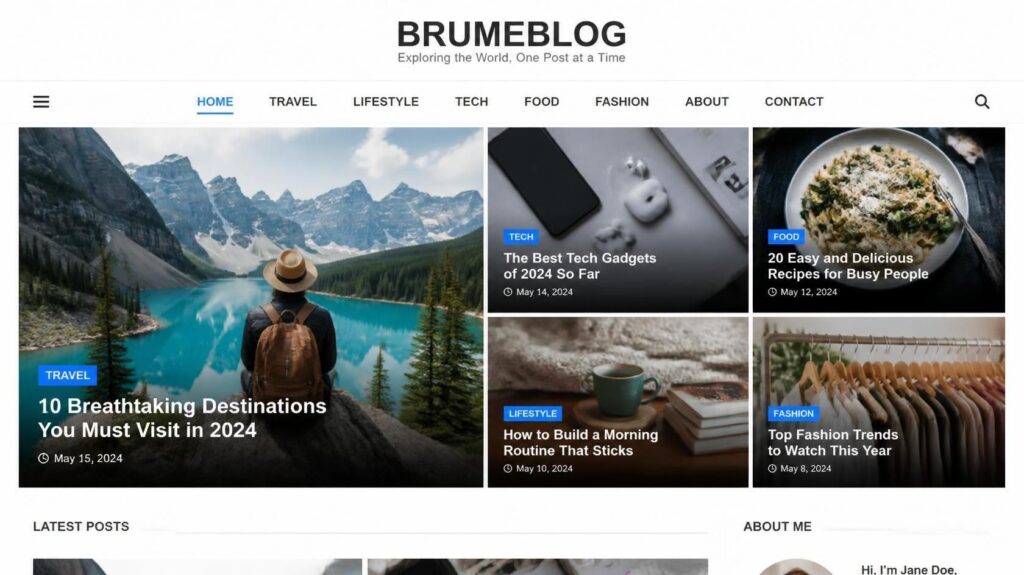
Finding a new website for reading articles, exploring ideas, or learning about online trends can be useful, but it is important to understand what a platform offers before trusting it. BrumeBlog.com is a website name that may lead users to look for information about its purpose, content, reliability, and overall user experience. However, a website’s name alone does not confirm who operates it, how its content is created, or whether it follows strong privacy and security practices.
This guide explains how to evaluate BrumeBlog.com, what to check before using it, and how to distinguish verified information from assumptions. It also covers website credibility, content quality, privacy risks, search engine visibility, and practical safety steps. Whether you discovered the domain through Google, social media, or a shared link, these checks can help you make an informed decision. The goal is to provide a balanced review without presenting unverified claims as established facts.
What Is BrumeBlog.com?
BrumeBlog.com appears, from its domain name, to be associated with blogging or online publishing. The word “blog” commonly refers to a website that publishes articles, guides, opinions, news, or other written content. However, the name itself does not establish the site’s actual purpose, ownership, subject areas, or publishing model.
Before treating BrumeBlog.com as an established information source, check whether its homepage clearly explains what the website does. Look for an About page, a list of content categories, author profiles, and recent publications. These details can help you determine whether the platform focuses on technology, lifestyle, business, entertainment, or another subject. If these details are missing or cannot be independently confirmed, keep your conclusions limited to what you can actually observe.
A reliable assessment should separate the domain’s apparent purpose from its verified features. For example, a website may look like a general blog but contain promotional articles, sponsored posts, user submissions, or links to outside services. Each format has different strengths and risks. Reviewing the actual pages, rather than relying only on the domain name or a third-party description, is the best starting point.
What Type of Content Does BrumeBlog.com Publish?
The content available on BrumeBlog.com should be reviewed directly before assigning the website to a specific niche. A blog can publish educational guides, product discussions, opinion pieces, entertainment articles, or practical tutorials. Without verified examples from the website, it would be misleading to claim that BrumeBlog.com specializes in any particular category.
Start by opening several articles and comparing their subjects, structure, and level of detail. Check whether the headlines accurately describe the content and whether the articles answer the questions they promise to address. Useful publications typically offer clear explanations, relevant examples, and enough context for readers to understand the topic. Articles that rely on vague claims, unsupported statistics, or repeated wording deserve closer attention.
It is also worth checking publication dates and author information. Recent dates do not automatically make an article accurate, and an author biography does not guarantee expertise. However, transparent authorship, credible references, and corrections to outdated information can help establish trust. If an article discusses health, finance, cybersecurity, or legal issues, look for stronger evidence and qualified sources rather than accepting its advice at face value.
How to Evaluate BrumeBlog.com Content Quality
Content quality matters because readers often use online articles to make decisions, solve problems, or learn unfamiliar subjects. When assessing BrumeBlog.com, focus on accuracy, originality, usefulness, and clarity instead of judging the site only by its design. A polished page can still contain weak information, while a simple layout can support excellent research and practical guidance.
Check whether factual statements include evidence that readers can verify. Strong articles often reference official documentation, recognized institutions, original research, or subject experts. For example, an article about online privacy should explain relevant risks and point readers toward trustworthy security resources. A product review should distinguish personal experience from manufacturer claims and sponsored material. If the site makes broad statements without showing how they were established, treat those statements cautiously.
Originality is another important factor. Compare a few distinctive sentences with the sources cited in the article, and look for clear attribution when outside material is used. Similar wording does not automatically prove misconduct, but copied passages without proper credit can reduce confidence in a publication. For a useful evaluation, consider the full article, the evidence behind its claims, and whether it gives readers enough information to reach their own conclusions.
Is BrumeBlog.com Legit or a Scam?
It is not possible to determine whether BrumeBlog.com is legitimate or fraudulent from its domain name alone. A fair conclusion requires evidence about the website’s operation, ownership, behavior, and any services it asks visitors to use. Without that evidence, labeling the platform a scam would be premature. Likewise, assuming it is trustworthy without checking its practices would be equally unwise.
Begin with the website’s basic transparency. Look for a working contact page, an About section, clear terms of use, and a privacy policy that explains how information is handled. If the site sells products or promotes paid services, check the business identity, payment terms, cancellation rules, and refund process. These details do not guarantee legitimacy, but missing or contradictory information can be a reason to investigate further.
Next, review how the website behaves. Unexpected redirects, aggressive pop-ups, fake download buttons, requests for unnecessary personal information, and pressure to make immediate payments are warning signs. Search for independent reports using the exact domain name, but assess the quality and date of each result. A lack of complaints does not prove safety, especially for a small or newly established site. Until reliable evidence is available, the most accurate position is to treat BrumeBlog.com as unverified rather than definitively safe or fraudulent.
How to Check the Safety and Security of BrumeBlog.com
Website security involves more than whether a homepage loads correctly. Before using BrumeBlog.com, check whether the address begins with HTTPS and whether your browser displays any security warnings. HTTPS encrypts data sent between your browser and the website, helping protect information in transit. However, it does not prove that the website owner is honest, that its articles are accurate, or that every linked service is safe.
You can also use reputable security tools to investigate a domain. Services such as Google Safe Browsing’s site status checker and VirusTotal can provide useful signals about known threats or suspicious activity. Their results should not be treated as absolute guarantees. A new threat may not have been detected yet, and an unfamiliar domain may have little history for security services to assess.
Avoid downloading files or installing browser extensions simply because an article recommends them. If a page requests payment details, identity documents, or login credentials, ask whether the request is necessary for the service being offered. Use unique passwords and a password manager when creating accounts on websites you have independently assessed. If your browser or security software raises a warning, do not bypass it just to access the page.
Does BrumeBlog.com Protect User Privacy?
A website’s privacy practices determine what happens to information visitors share with it. Depending on its setup, a website may collect technical information, use cookies, measure traffic, display advertisements, or process details submitted through contact forms. These are common online practices, but the specific information collected by BrumeBlog.com cannot be confirmed without reviewing its privacy documentation and technical behavior.
Look for a privacy policy that identifies the types of information collected and explains why they are needed. It should also clarify whether information is shared with advertising partners, analytics providers, or other third parties. If the website allows account creation, check how it handles account data and whether it provides a process for requesting deletion. For U.S. readers, applicable privacy rights may depend on their state and the site’s activities.
You can reduce unnecessary data exposure by limiting permissions and avoiding sensitive submissions. Do not enter your Social Security number, financial account details, or other confidential information into a general website unless there is a clear, legitimate reason and you have verified the recipient. Review cookie settings when available, and consider using browser privacy protections. If BrumeBlog.com does not explain its data practices clearly, avoid sharing information beyond what is necessary to view public pages.
BrumeBlog.com and Search Engine Optimization
Search engine optimization, commonly called SEO, helps websites make their pages easier for search engines to discover, understand, and present to relevant users. A blog may use descriptive titles, clear headings, internal links, structured page layouts, and useful content to improve its visibility. However, a domain’s existence does not establish that it has strong search rankings, substantial traffic, or recognized authority.
To evaluate BrumeBlog.com’s search visibility, examine its indexed pages and the quality of its published material. You can search for the exact domain in Google, review pages that appear in the results, and check whether article titles match the content. SEO research tools may provide estimates of backlinks, organic keywords, and traffic, but these figures are not the same as verified analytics data. Treat third-party estimates as directional indicators rather than confirmed performance statistics.
If the website accepts guest posts or sells publication placements, investigate those services separately from its editorial quality. Ask whether links are editorially justified, whether sponsored content is disclosed, and whether paid links follow Google’s applicable spam policies. A publication placement does not automatically improve rankings, and buying links intended to manipulate search results can create SEO risks. For website owners, useful content, honest attribution, and a good reader experience are more sustainable goals than chasing backlinks alone.

Humair is the founder of PeakMagzine.com and a seasoned digital strategist with over 15 years of SEO experience. He specializes in creating high-quality, optimized content that drives organic traffic, improves search rankings, and helps brands grow their online presence effectively.
