
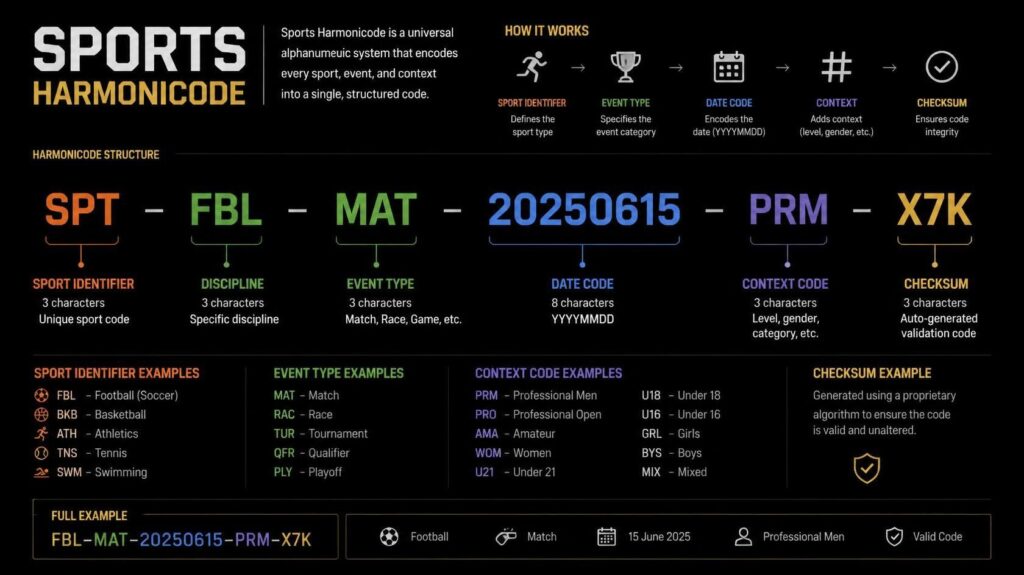
Sports technology is changing how athletes train, coaches evaluate performance, and fans follow their favorite teams. Against this background, the search term sports harmonicode has attracted attention from people looking for information about sports analytics, gaming, performance tracking, and digital sports platforms. However, understanding the term requires a closer look at what is publicly established and what remains unclear.
Harmonicode Sports does not have a clearly established, universally recognized definition as an official sport or standardized sports technology system. Depending on the context, the term may refer to a website, a gaming concept, or an approach to combining sports with digital tools. These possibilities should not be treated as interchangeable without reliable evidence.
This guide explains what Harmonicode Sports may mean, how related technologies work, what features users should expect from a sports platform, and how to verify information before relying on it. It also explores artificial intelligence, sports analytics, data privacy, and the future of technology in athletics.
What Is Harmonicode Sports?
Harmonicode Sports is a term that appears to connect sports with digital technology, gaming, or performance analysis. However, its exact meaning cannot be confirmed as a standardized concept from the term alone. Readers should distinguish between a descriptive phrase, a specific online platform, and an established sports organization.
When researching Harmonicode Sports, look for an official website, a clear company identity, documented features, and reliable references. These details help establish whether a particular service actually exists and what it offers. Without such evidence, claims about its popularity, performance tools, or official status should be treated cautiously.
Definition at a Glance
In simple terms, sports harmonicode can be understood as a search phrase associated with sports-related digital experiences or technology. It may be used by readers exploring sports analytics, interactive games, fitness tracking, or online sports information.
That interpretation is a starting point, not a verified definition of a named product. A reliable explanation should identify the organization behind the term and provide evidence of its purpose. Until those details are established, it is best to avoid describing Harmonicode Sports as a confirmed analytics platform or official athletic discipline.
What Is Harmonicode Gaming?
Harmonicode gaming may refer to a gaming-related interpretation of the Harmonicode name. In a broader context, sports gaming can include simulations, competitive video games, interactive training applications, and digital competitions.
These activities use different technologies and serve different audiences. A sports simulation might reproduce match conditions, while a fitness game could encourage physical movement through interactive challenges. However, the existence of these general categories does not prove that a particular Harmonicode gaming product offers them. Users should check the product description, supported devices, rules, and developer information before making assumptions.
What Is Harmonicode.com?
Harmonicode.com may be searched by people trying to locate a website associated with the Harmonicode name. A domain name alone, however, does not establish the site’s ownership, services, reputation, or connection to sports.
Before using a website, examine its About page, contact information, privacy policy, terms of service, and published content. Check whether its claims can be confirmed through independent sources. If the website promotes sports data, gaming features, or training tools, look for demonstrations and documentation. Avoid entering sensitive personal information until you understand who operates the service and how your information will be handled.
Why Are People Searching for Harmonicode Sports?
People often search unfamiliar terms because they have encountered them in articles, search results, social media posts, gaming discussions, or online recommendations. Someone searching for sports harmonicode may want a definition, a website review, information about a possible gaming platform, or an explanation of sports technology.
These are different search intentions. A person looking for a live-score service needs different information from someone researching athletic performance software. Identifying the purpose behind the search helps readers avoid irrelevant pages and unsupported claims.
Common Search Intent
Search intent generally falls into four categories: informational, navigational, commercial, and transactional. Informational searches seek explanations. Navigational searches aim to locate a specific website. Commercial searches compare products, while transactional searches indicate an intention to register, subscribe, or purchase something.
For Harmonicode Sports, users may be trying to discover what the term means, whether a related website is legitimate, or whether a particular service provides sports data. Search results should be evaluated according to the user’s actual goal rather than assuming every page refers to the same product.
Why Different Websites May Define Harmonicode Differently
Websites can describe unfamiliar terms differently because they interpret limited information, target different audiences, or use related keywords to attract search traffic. Some may associate Harmonicode with gaming, while others may connect it to performance tracking or sports news.
These descriptions are not automatically evidence of a shared platform. Compare publication dates, author credentials, references, and links to primary sources. If several pages repeat the same claim without independent evidence, repetition alone does not make it reliable. A careful reader should separate confirmed facts from interpretations and marketing language.
How Does Harmonicode Sport Work?
There is no established, verified technical specification that explains how a product called Harmonicode Sport operates. Therefore, its actual workflow should not be described as fact without documentation from its developer or operator.
However, sports technology provides a useful framework for understanding what a related system might do. A conventional sports analytics tool can collect information, process it, display measurements, and help users interpret performance. The exact process depends on the available equipment, software, data sources, and intended purpose.
The Technology Behind Harmonicode Sport
A typical sports technology system may combine mobile applications, cloud computing, databases, sensors, and analytical software. For example, a training application might collect workout information from a phone or wearable device and display it through a dashboard.
An analytics platform could also process match statistics or recorded video. These functions are common across the industry, but they should not be attributed to Harmonicode Sport unless its features are independently confirmed. Users should look for product documentation explaining supported devices, data inputs, processing methods, and system limitations.
Data, Analytics, and Performance Tracking
Sports analytics turns raw information into measurements that athletes and coaches can understand. Depending on the system, data may include running distance, heart rate, movement speed, shot accuracy, or possession statistics.
Performance tracking is most useful when measurements are consistent and interpreted in context. A single workout rarely explains an athlete’s overall condition, and a high number does not always indicate improvement. If a Harmonicode-related service claims to provide these capabilities, check how it collects information and whether its measurements have been validated.
Is Harmonicode Sport a Real or Official Sport?
Harmonicode Sport should not be described as an officially recognized sport without evidence from a governing body or an established competition structure. The term alone does not demonstrate that it has standardized rules, organized leagues, recognized championships, or formal athletic regulations.
This distinction matters because a digital sports product and a sport are not the same thing. A platform may cover existing sports, support training, or host gaming activities without establishing a new athletic discipline.
Harmonicode Sport vs. Traditional Sports
Traditional sports such as basketball, soccer, tennis, and American football have recognizable rules and established organizations. Their competitions are organized through schools, clubs, leagues, national bodies, or international federations.
A digital sports concept may instead focus on software, data analysis, interactive entertainment, or virtual competition. These activities can support athletic participation, but their existence does not make them equivalent to an officially governed sport. To assess Harmonicode Sport, look for documented rules, recognized organizers, and verifiable competitive events.
Common Misconceptions About Harmonicode Sport
One common misunderstanding is that a name containing the word “sport” must represent an established athletic discipline. Another is that references to artificial intelligence or advanced analytics prove a platform uses sophisticated technology.
Neither assumption is reliable. Marketing terms may describe an idea rather than a functioning service. Similarly, a website mentioning sports data does not necessarily provide verified live statistics. Readers should confirm specific claims before repeating them or using them to make purchasing decisions.
Is Harmonicode Sport an Official Sport?
There is insufficient established evidence to confirm Harmonicode Sport as an officially recognized sport. Official recognition would normally require identifiable organizers, documented competition rules, and evidence of recognition by an appropriate governing body where applicable.
This does not prove that no project uses the name. It means its official status should remain unconfirmed until reliable documentation becomes available. Readers should also distinguish recognition of a sport from registration of a company, ownership of a domain, or publication of a sports-related website.
What Features Should a Sports Platform Offer?
A useful sports platform should help users find accurate information without making navigation difficult. Depending on its purpose, it may provide schedules, live scores, player statistics, standings, news, video highlights, or training data.
The most important features depend on the audience. Fans may prioritize match updates, while coaches need detailed performance reports. Before choosing any service associated with Harmonicode Sports, confirm that the advertised tools are available and that their data sources are clearly identified.
Live Scores and Game Updates
Live scores help fans follow games without watching every minute of a broadcast. A reliable service should show the current score, game status, elapsed time where applicable, and significant events.
Users should check whether updates arrive directly from an official competition feed or another dependable provider. Delayed or incorrectly labeled information can be misleading, especially during close games. If a platform claims to provide live scores, test its coverage against an official league website before relying on it.
Schedules and Upcoming Games
Sports schedules help users find game dates, start times, venues, and broadcast information. A strong platform should identify the relevant league and display time zones clearly.
Schedules can change because of weather, venue issues, broadcasting decisions, or competition rules. Therefore, users should confirm important details with the league or event organizer. A schedule displayed on an independent website is helpful, but it should not replace official announcements when travel plans or ticket purchases depend on accurate information.
Team and Player Statistics
Team and player statistics provide insight into performance across individual games and entire seasons. Common measures include goals, assists, passing accuracy, rebounds, rushing yards, and shooting percentages.
Useful platforms explain their statistical definitions and provide enough context to compare results fairly. For example, a player’s scoring total does not reveal defensive contributions or playing time. Before trusting a Harmonicode-related statistics service, determine which competitions it covers and whether its numbers match recognized statistical providers.
Standings and Rankings
Standings summarize team performance using measures such as wins, losses, draws, points, and tiebreakers. Rankings may use league rules, tournament results, expert assessments, or mathematical rating systems.
These methods are not interchangeable. A team can lead its division while holding a different position in a national ranking. A credible platform should explain its methodology and update standings after relevant events. Users should consult the competition’s official table whenever qualification, playoff positions, or championship eligibility matters.
Harmonicode Sports and Sports Data Accuracy
Accurate information is essential for anyone following sports or evaluating athletic performance. Incorrect statistics can mislead fans, distort comparisons, and affect decisions made by teams or analysts.
Because Harmonicode Sports does not have a confirmed, documented data system established by the term alone, its accuracy cannot be assumed. Instead, users should evaluate any associated service using the same standards applied to other sports websites and analytical tools.
Why Data Sources Matter
Sports information can come from league databases, official team reports, licensed data providers, broadcasters, journalists, or independent contributors. Each source has different strengths, update schedules, and verification processes.
Primary sources are especially valuable for final scores, official rosters, disciplinary decisions, and competition rules. Secondary sources can add analysis and context, but errors may occur when information is copied between websites. A trustworthy platform identifies its sources and corrects mistakes transparently.
How Sports Data Can Be Verified
Start by comparing a platform’s claims with the official league, team, or tournament website. Check event dates, player names, final scores, and statistical definitions.
For performance measurements, examine whether the tool explains its methods and limitations. Look for independent validation when a service makes strong claims about predictive accuracy or athletic improvement. Screenshots and promotional testimonials may offer context, but they are not substitutes for documented evidence.
Gaming Harmonicode: How Technology Extends Beyond Traditional Sports
Sports gaming combines elements of athletic competition with software and interactive entertainment. It includes sports simulations, management games, virtual competitions, and esports titles. These experiences can help users learn strategies or enjoy competitive play, although they do not always reproduce real-world athletic demands.
The connection between gaming and Harmonicode remains unverified unless a specific product or developer documents it. General gaming concepts can explain the broader industry, but they should not be presented as confirmed Harmonicode features.
What Are Harmonicode Games?
The phrase Harmonicode games may refer to games associated with the name, but a specific catalog or product offering has not been established here. Before assuming games are available, look for official listings, developer information, gameplay demonstrations, and supported platforms.
In the wider gaming industry, sports games can simulate matches, teach tactics, or create virtual competitions. Some emphasize realistic player movements, while others focus on management or arcade-style entertainment. These distinctions help users determine whether a game suits their interests.
Team Harmonicode: What Does It Mean?
Team Harmonicode could be interpreted as a team, group, or project using the Harmonicode name. However, the phrase alone does not establish that a professional sports team or registered esports organization exists.
If you encounter a team using this label, check its official roster, competition history, social media accounts, and organizer information. Verified match results and consistent public records provide stronger evidence than an isolated mention on an unfamiliar website.
Harmonicode and Esports
Esports involves organized competitive video gaming, often featuring teams, tournaments, rankings, and professional players. Established esports titles have identifiable publishers, competition rules, and tournament organizers.
A Harmonicode-related esports connection would need similar evidence. Users should verify the game involved, the organizer, and the competition format. They should also distinguish between casual gaming communities and officially organized events, since participation requirements, prizes, and rules can differ substantially.
How Harmonicode Sport Could Be Used in the Real World
Sports technology can support training, competition analysis, recovery planning, and recreational fitness. These uses depend on measurable goals and suitable tools rather than a particular brand name.
If a Harmonicode-related product eventually documents relevant capabilities, its practical value should be evaluated against established alternatives. Until then, the examples below describe general applications of sports technology, not confirmed Harmonicode services.
Professional Team Sports
Professional teams use video analysis, player tracking, and statistical models to evaluate tactics and individual contributions. Coaches may examine positioning, passing patterns, defensive spacing, and workload across a season.
These tools can reveal patterns that are difficult to notice during a live match. However, statistics need context. A successful strategy in one game may fail against a different opponent, so coaches combine data with observation, experience, and tactical judgment.
Running and Endurance Sports
Runners and cyclists often use GPS watches, heart-rate monitors, and training applications to track distance, pace, elevation, and workout intensity. Reviewing these measurements can help athletes assess progress and plan training sessions.
Long-term trends are generally more informative than isolated results. Weather, terrain, sleep, and fatigue can all affect performance. Athletes should therefore avoid interpreting one unusually fast or slow workout as definitive evidence of improvement or decline.
Strength and Conditioning
Strength and conditioning programs can use repetition counts, lifting loads, movement assessments, and recovery records to guide training. Some systems also estimate movement speed or analyze exercise technique through video.
These measurements can help identify patterns, but they do not replace proper instruction. Incorrect technique, unsuitable training loads, and inadequate recovery can increase injury risk. Qualified coaches and appropriate medical professionals should guide decisions when health or rehabilitation concerns are involved.
Esports and Gaming
Esports athletes may review reaction times, accuracy, movement patterns, communication, and match statistics. Training software can help players identify recurring mistakes and compare performance across sessions.
However, gaming performance also depends on strategy, teamwork, concentration, and decision-making under pressure. A dashboard may highlight weaknesses, but players still need deliberate practice and feedback. Any claimed Harmonicode esports feature should be verified through product documentation before use.
Technologies That Support the Harmonicode Approach
Sports technology combines several fields to collect, organize, and interpret information. Artificial intelligence, wearable sensors, computer vision, and personalized training software are among the technologies used across the industry.
These tools offer a useful framework for understanding sports analytics, but no particular implementation should be attributed to Harmonicode without evidence. The relevant question is whether a real product explains its technology and demonstrates that it works as claimed.
Artificial Intelligence and Sports Analytics
Artificial intelligence can help identify patterns in large datasets, estimate probabilities, and summarize performance trends. Sports organizations may use machine-learning models to study tactics, workload, or opponent behavior.
AI-generated results depend on the quality of the input data and the model’s design. Predictions are not guarantees, and a model trained on one league may perform poorly in another. Users should look for clear explanations of the system’s purpose, limitations, and evaluation methods.
Wearable Technology
Wearable devices include smartwatches, fitness bands, GPS trackers, and specialized athletic sensors. Depending on the device, they may record heart rate, movement, distance, sleep estimates, or training intensity.
These measurements can support fitness planning, but accuracy varies by device and activity. Wrist-based heart-rate readings, for example, may be affected by movement or poor sensor contact. Athletes should understand what their equipment measures and avoid treating consumer-device estimates as medical diagnoses.
Computer Vision and Video Analysis
Computer vision allows software to analyze images and video. Sports applications may use it to track players, estimate body positions, measure movement, or review technique.
The results depend on camera placement, image quality, lighting, and the complexity of the movement. A system may struggle when players overlap or move outside the camera’s view. Reliable applications explain their measurement limits and allow coaches to review results rather than accepting automated conclusions without question.
Personalized Training Technology
Personalized training tools adjust workouts based on goals, ability, training history, and available measurements. Some applications recommend changes in intensity or recovery based on previous sessions.
Personalization is most useful when recommendations are realistic and transparent. A beginner and an experienced athlete should not automatically receive identical plans. Users should also be able to modify unsuitable recommendations and seek qualified guidance when an exercise plan involves injury recovery or other health concerns.
Harmonicode Sport vs. Traditional Coaching
Traditional coaching relies on observation, experience, communication, and knowledge of the athlete. Sports technology adds measurable information that can help coaches review performance more consistently.
The two approaches can work together. Data may identify a drop in running speed or a recurring technical error, while a coach investigates its cause. Numbers cannot fully capture motivation, team relationships, confidence, or personal circumstances. Because Harmonicode Sport’s exact capabilities are unconfirmed, any direct comparison must remain conceptual rather than a claim about a specific product.
What to Look for When Comparing Sports Platforms
Choosing a sports platform requires more than reviewing its name or promotional claims. Users should assess the information provided, the quality of its sources, its coverage, and the ease of using its tools.
A suitable platform should explain what it does and make important limitations visible. For Harmonicode Sports, the first step is confirming that the specific website or service exists and provides the advertised functions.
Data Accuracy and Reliability
Look for named data sources, clear timestamps, correction policies, and consistent statistics. If a platform provides predictions, it should explain that forecasts involve uncertainty rather than presenting them as guaranteed outcomes.
Compare important information with official league or team records. For training tools, check whether measurement methods and validation evidence are available. A polished interface cannot compensate for inaccurate data.
Coverage and Availability
Check which sports, leagues, teams, countries, and devices a service supports. A platform may cover major U.S. leagues without offering college sports, minor leagues, or international competitions.
Availability can also depend on subscriptions, geographic restrictions, or device compatibility. Confirm these details before creating an account or paying for access. Do not assume Harmonicode Sports covers the NFL, NBA, MLB, NHL, or NCAA competitions without a current, verifiable listing.
User Experience and Accessibility
A good platform should load reliably, display information clearly, and work on supported mobile and desktop devices. Useful accessibility features include readable text, keyboard navigation, captions where appropriate, and layouts compatible with assistive technologies.
Check whether essential features require an account and whether the interface explains its controls. A simple, transparent service is often more useful than one with many confusing features and unclear privacy practices.
Harmonicode Sports vs. Official Sports Sources
Official sports sources are generally the best starting point for confirmed scores, league schedules, rosters, rule changes, and disciplinary announcements. Examples include the NFL’s official website, NBA.com, MLB.com, NHL.com, and NCAA resources for their respective competitions.
An independent sports platform may offer a convenient combined view of multiple leagues, but its information should be checked against primary sources when accuracy matters. A Harmonicode-branded website should be judged by the same standard. Until its ownership, data sources, and coverage are verified, it should not be treated as an official partner of a sports league.
Benefits and Limitations of Harmonicode Sport
The possible value of a sports-related digital concept depends on its actual features, intended users, and evidence of effectiveness. General sports technology can improve access to information and help people review performance, but those benefits should not automatically be assigned to an unverified product.
Evaluating both strengths and weaknesses prevents unrealistic expectations. Users should determine what a service demonstrably does, what information it collects, and whether its features solve a real problem.
Potential Advantages
If a related platform provides reliable sports data or useful training tools, possible advantages could include:
- Easier access to sports information.
- Clearer views of performance trends.
- More convenient tracking across training sessions.
- Better organization of team or player statistics.
- Support for evidence-informed coaching decisions.
These are potential benefits of sports technology in general. They are not verified outcomes for Harmonicode Sports without product-specific evidence.
Current Limitations
The main limitation is the lack of a clearly established definition and independently confirmed feature set for Harmonicode Sports. Without that information, users cannot confidently assess its coverage, reliability, pricing, or technical performance.
Other limitations common to sports technology include inaccurate measurements, incomplete datasets, subscription costs, device compatibility, and privacy risks. Even sophisticated systems can produce misleading recommendations when their data is poor or their conclusions are interpreted without context.
Common Misconceptions About Harmonicode Sport
Unfamiliar sports technology terms can create confusion, particularly when online articles use similar wording for different concepts. Separating documented facts from assumptions is essential for accurate research.
The following misconceptions apply to how readers should evaluate Harmonicode Sport and comparable digital sports products.
Misconception 1: Harmonicode Sport Is an Official Sport
There is no sufficient evidence here to establish Harmonicode Sport as a formally recognized sport. An official status claim requires supporting information about governing organizations, competition rules, and recognized events.
A website or online discussion using the term is not enough to prove recognition.
Misconception 2: AI Can Replace Coaches
AI can assist with data analysis, but it cannot reliably replace every part of coaching. Coaches interpret physical performance alongside tactics, confidence, communication, and individual needs.
Automated recommendations should support informed decisions rather than eliminate human judgment.
Misconception 3: Only Professional Athletes Can Benefit
Recreational athletes can use fitness trackers, running applications, and training logs to monitor progress. Beginners may benefit from simple measurements and realistic goals.
However, users should select tools that match their experience and avoid collecting unnecessary data simply because it is available.
Misconception 4: More Data Always Means Better Performance
Collecting more measurements does not guarantee better results. Poor-quality data can confuse users, while excessive tracking may distract them from basic training principles.
The best approach focuses on a small number of useful measures and interprets them consistently over time.
Security, Privacy, and Data Considerations
Sports platforms may collect account details, device information, location data, workout histories, or biometric measurements. Before using a service, determine what information it requests and whether the data collection is necessary for its advertised functions.
These checks are particularly important for children, student athletes, and people sharing information with teams or coaches. A clear privacy policy should explain data collection, storage, sharing, retention, and deletion.
Data Privacy
Review the privacy policy before connecting a wearable device or uploading training records. Check whether information is shared with advertisers, analytics providers, or third parties, and whether users can delete their accounts and associated data.
Precise location and biometric information deserve particular care. Avoid sharing sensitive details unless you understand the purpose and potential consequences. For U.S. users, applicable privacy protections depend on the type of data, the organization, and relevant federal or state law.
Platform Security
Look for HTTPS, secure account recovery, multifactor authentication where available, and clear contact details for the operator. Use unique passwords and avoid downloading software from unknown sources.
Security claims should be supported by credible documentation rather than promotional statements alone. If a website requests unnecessary permissions, sensitive payment details, or unusual downloads, stop and investigate before proceeding.
Accuracy and Transparency
A trustworthy platform should explain where its information comes from and acknowledge errors. Users should be able to distinguish verified facts from predictions, estimates, and opinions.
For AI-powered services, transparency also means explaining what the tool can and cannot determine. When these details are missing, avoid relying on its output for consequential athletic, financial, or health-related decisions.
The Future of Harmonicode Sport and Sports Technology
Sports technology is likely to continue developing through improvements in analytics, wearable devices, video processing, and personalized software. Whether Harmonicode becomes an established product or remains a loosely used search term will depend on verifiable developments rather than speculation.
Readers should follow official product announcements and independent reporting for evidence of new features. General industry trends can indicate what is technically possible, but they cannot establish what a particular Harmonicode service currently offers.
Smarter Artificial Intelligence
AI systems may become better at summarizing complex performance data and identifying useful patterns. Better evaluation methods could also help users understand how reliable a recommendation is.
Even so, forecasts will remain uncertain. Human review, representative data, and transparent testing will continue to matter.
More Advanced Wearable Technology
Wearable devices may improve in comfort, battery life, sensor quality, and integration with training applications. Better measurements could help athletes monitor workloads and identify changes across longer periods.
However, new sensors will still require validation. More precise equipment is valuable only when its measurements answer meaningful questions.
Computer Vision and Video Analysis
Video analysis may become easier to use as software improves its ability to track movement from ordinary cameras. This could make some performance-review tools more accessible to schools, clubs, and recreational athletes.
Privacy, camera placement, and measurement accuracy will remain important challenges. Automated analysis should be tested before it is used to evaluate technique or make consequential decisions.
More Personalized Training
Training applications may increasingly adapt recommendations to fitness goals, available equipment, and previous workouts. Well-designed systems could help users follow consistent plans and monitor gradual progress.
Personalized recommendations should still account for individual differences and uncertainty. They should also allow users to seek human guidance when an automated plan does not fit their needs.
Challenges That Still Need to Be Solved
Sports technology faces practical and ethical challenges that extend beyond technical performance. These include data ownership, unequal access, privacy risks, and the danger of treating automated results as unquestionable facts.
Any future Harmonicode product would need to address these concerns transparently to earn users’ trust. The same standards apply to established sports applications.
Privacy and Data Ownership
Athletes should understand who controls their records and whether they can transfer or delete their information. Team-issued devices may introduce additional questions about employer, school, or coach access.
Clear policies are essential, especially when data may influence selection, training decisions, or sponsorship opportunities. Users should know their rights before agreeing to monitoring.
Accessibility
Advanced sports technology can be expensive and may require recent phones, subscriptions, or specialized equipment. These requirements can limit access for smaller clubs, schools, and recreational athletes.
Affordable alternatives, clear interfaces, and support for common devices can make useful tools available to more people. Effective coaching should not depend entirely on costly software.
The Importance of Human Judgment
Measurements can describe what happened, but they do not always explain why it happened. Fatigue, stress, tactics, environment, and personal circumstances can affect results in ways that a dashboard may not capture.
Coaches and athletes should combine relevant data with observation and experience. Human judgment remains important when interpreting unusual measurements, adjusting training, and balancing performance goals with safety.
Frequently Asked Questions
What Is Harmonicode Sports?
Harmonicode Sports is an ambiguously defined term associated with searches about sports, gaming, or digital technology. Its exact meaning and any specific product features should be confirmed through reliable sources.
What Is Harmonicode Sport?
Harmonicode Sport may describe a sports-related digital concept, but its precise technical definition is not established here. Avoid assuming that it is a verified analytics platform or athletic discipline.
Is Harmonicode Sport an Official Sport?
Its official status has not been established by sufficient evidence. Confirmation would require reliable documentation from recognized organizers or relevant governing bodies.
Is Harmonicode Sports a Sports News Website?
That cannot be confirmed from the name alone. Check the website’s actual content, ownership details, publication history, and sources before classifying it as a sports news service.
Can Harmonicode Sports Provide Live Scores?
There is not enough verified information to confirm live-score functionality. Check the service’s current feature list and compare any scores with official competition sources.
Final Thoughts
The search term sports harmonicode raises useful questions about sports technology, digital gaming, analytics, and online information. However, its exact meaning and connection to any particular platform remain unclear without reliable, product-specific documentation. Readers should distinguish general industry capabilities from confirmed Harmonicode features and avoid treating an unfamiliar name as proof of official recognition.
When evaluating a related website, check its ownership, data sources, available features, privacy policy, and independent reputation. For live scores and official competition information, prioritize league and team websites. For training, choose tools with transparent methods and realistic claims. Ultimately, reliable evidence—not marketing language—is the best way to determine whether a sports platform deserves your time and trust.

Humair is the founder of PeakMagzine.com and a seasoned digital strategist with over 15 years of SEO experience. He specializes in creating high-quality, optimized content that drives organic traffic, improves search rankings, and helps brands grow their online presence effectively.
